Your customer writes in their language and gets an answer in it.
Your multilingual AI assistant answers in whatever language the customer writes in.
OpusDone always replies in the language the customer is writing in. That rule lives in the platform layer rather than in your instructions, so it holds on every channel and in every conversation. Only when it genuinely cannot tell does it fall back to your business default, which can be Spanish, English, Catalan, French, German, Italian, Portuguese, Dutch or Polish.
- Replies in the customer’s language
- Nine business default languages mapped
- Alerts in each teammate’s language
Reviewed
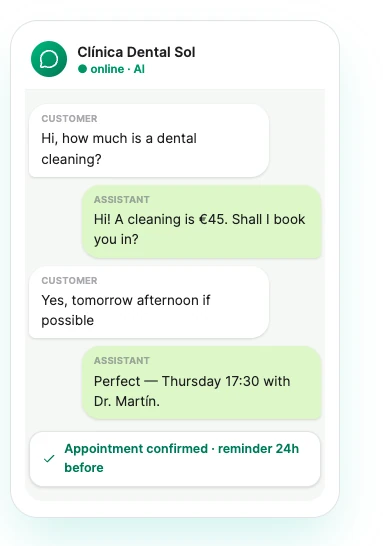
Where does language usually break in an AI assistant?
The customer switches mid-thread
Someone opens in English because your site is in English, then relaxes into Catalan two messages later. Matching on the last message rather than the first one is the whole point.
The team does not share a language
Two people on the same front desk read different languages. Sending both of them one alert in one language means one of them skims it.
The AI disclosure is written in the wrong one
A disclosure the customer cannot read is a line of text, not a notice. It is rendered in the customer’s language for exactly that reason.
What does multilingual mean in OpusDone?
Every customer who writes to you gets an answer in their own language.
You write your prices and your hours once, in your language. A customer writing in Dutch gets Dutch, one writing in Polish gets Polish, and nobody picks a flag from a menu. That is the difference between a visitor who books and a visitor who closes the tab.
The same rule, applied in three places.
The reply matches the message
Language is decided from what the customer wrote, not from your site’s language or a picker they have to find. The business default only comes into play when the signal is genuinely unclear.
The AI disclosure is rendered in the customer’s language too.
The alert matches the reader
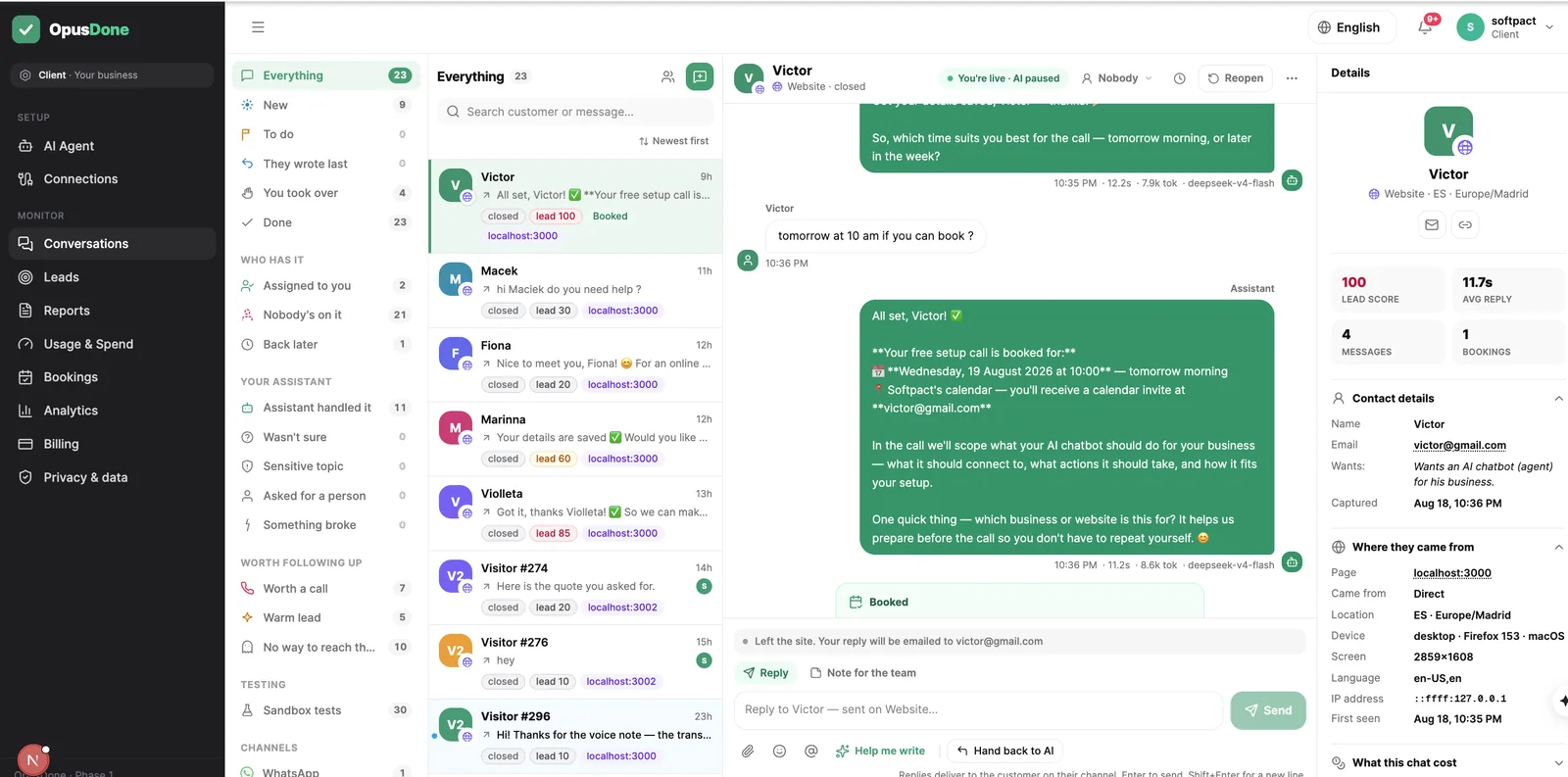
Owner alerts are rendered per recipient’s own language setting. Two teammates with different settings get the same escalation, each in their own language, from the same event.
In-app bell always on. Email always sent, never held by quiet hours.

The lead is still one lead
Someone who writes in French on the website and later in French on Telegram is one person, deduped on email, phone or visitor key. Language does not fragment the record.
Scored on the same published weights whatever language was used.

They type Dutch. It answers Dutch. You did nothing.
There is no language picker to design, no flags to choose between, and no second version of your site to maintain. You write your knowledge once, in your own language. The reply comes back in the language the visitor used.
- Detects the language from what the visitor typed, not from a browser setting or a flag they had to find.
- Falls back to a language you chose rather than guessing, when the message is too short to tell.
- Keeps your prices, names and terms exactly as you wrote them — it translates the sentence, not the facts.
- Your inbox stays readable: every conversation carries the language it happened in.
What does the OpusDone language rule not excuse?
Speaking someone’s language changes the wording of the answer. It does not change what the answer is allowed to contain.
It does not invent in any language
Prices, timelines, capabilities and availability come from live knowledge or they do not appear at all. Translation does not soften that.
It does not default first
The business default is a fallback for genuine uncertainty, not the starting point. Matching the customer comes first in the instruction and in practice.
It does not disclose in your language
The AI disclosure follows the customer, not the business. A Polish customer is told in Polish.
It does not translate a document for you
There is no vision capability and no document understanding. A file it cannot read gets an honest acknowledgement, an escalation, and the inbox shows what arrived.
It does not miss a request for a person
The keyword guardrail covers English and Spanish, including “speak to a human”, “quiero hablar con una persona”, “put me through” and “atención al cliente”. Beyond keywords, an explicit request for a human escalates on its own.
Multilingual chat questions, answered
Which languages can it reply in?
Does my knowledge base have to be translated?
Does language affect booking?
Do I need a separate assistant per language?
What language do my alerts arrive in?
How do I check it before customers see it?

More on how the assistant behaves
Your customer writes, your assistant answers in kind
Spanish, English, Catalan, French, German, Italian, Portuguese, Dutch and Polish. Only when it genuinely cannot tell does it fall back to your default. The AI disclosure renders in the customer’s language too.
Get started