It is 23:40 and they want to know what time breakfast stops.
The question comes from room 14, not from your website.
OpusDone answers the eleven questions every guest asks — breakfast, wifi, checkout, somewhere to eat — from knowledge you wrote and approved, in whatever language they typed in. Your guest is already inside the building. They are not booking anything; they want an answer at 23:40 without ringing a desk nobody is sitting at.
- Answers at 23:40, not at breakfast
- Every language your guests arrive in
- Late checkout always goes to a person
Reviewed

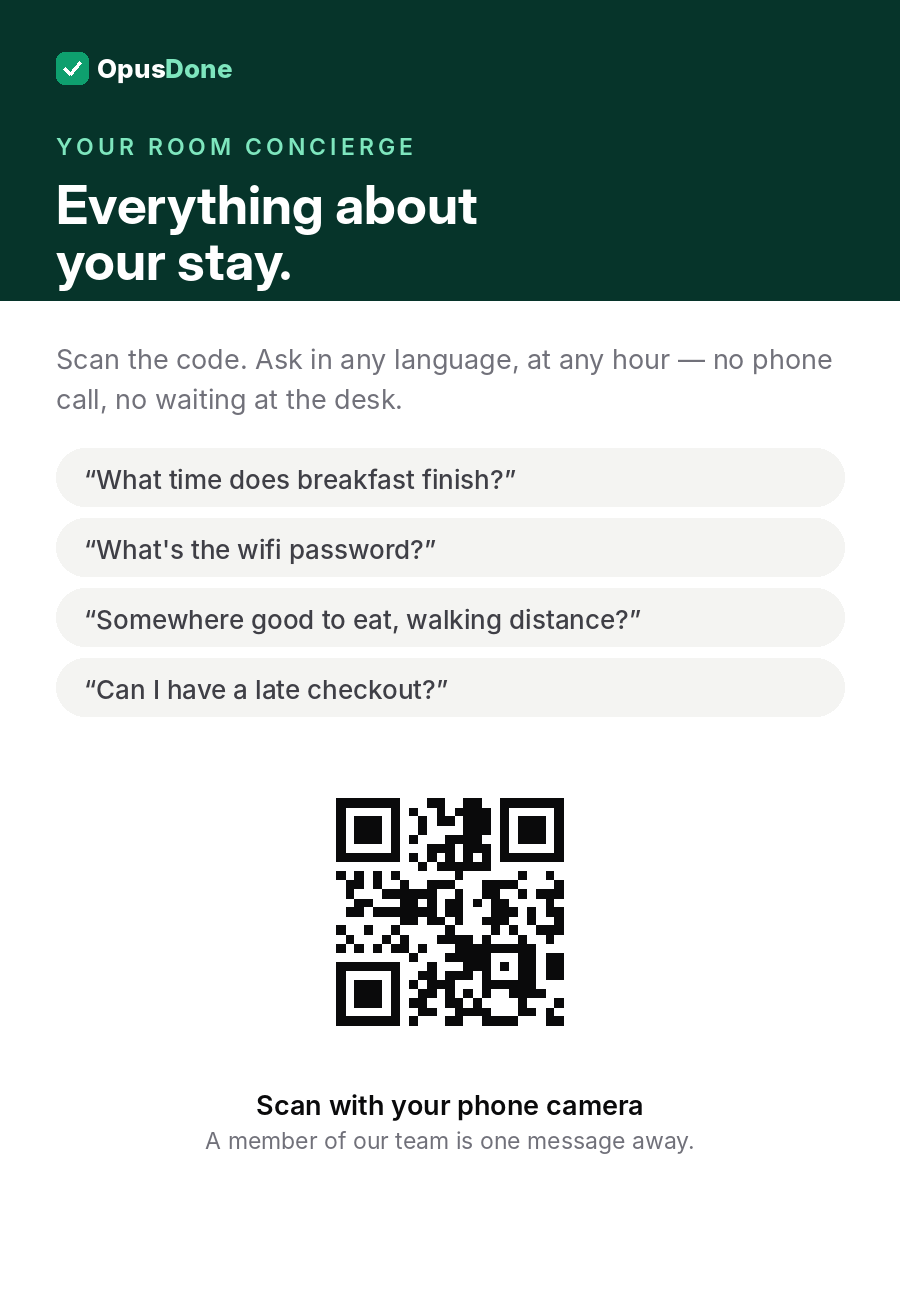
The best place for it is four feet from the bed.
A guest will not open your website from inside your building. They will scan the card next to the kettle, because it is there and it is one movement. That card answers in Polish, Dutch or Portuguese without you doing anything, and it works at three in the morning.
In the room
An A6 card by the kettle, or a sticker inside the wardrobe door where the hangers are.
In the entrance
Self check-in, a late arrival, which bell to press, where the lockbox is.
On the welcome note
One line at the bottom of the letter you already print for every guest.
In your check-in message
The same link in the message you already send, for the guests who never look at the card.
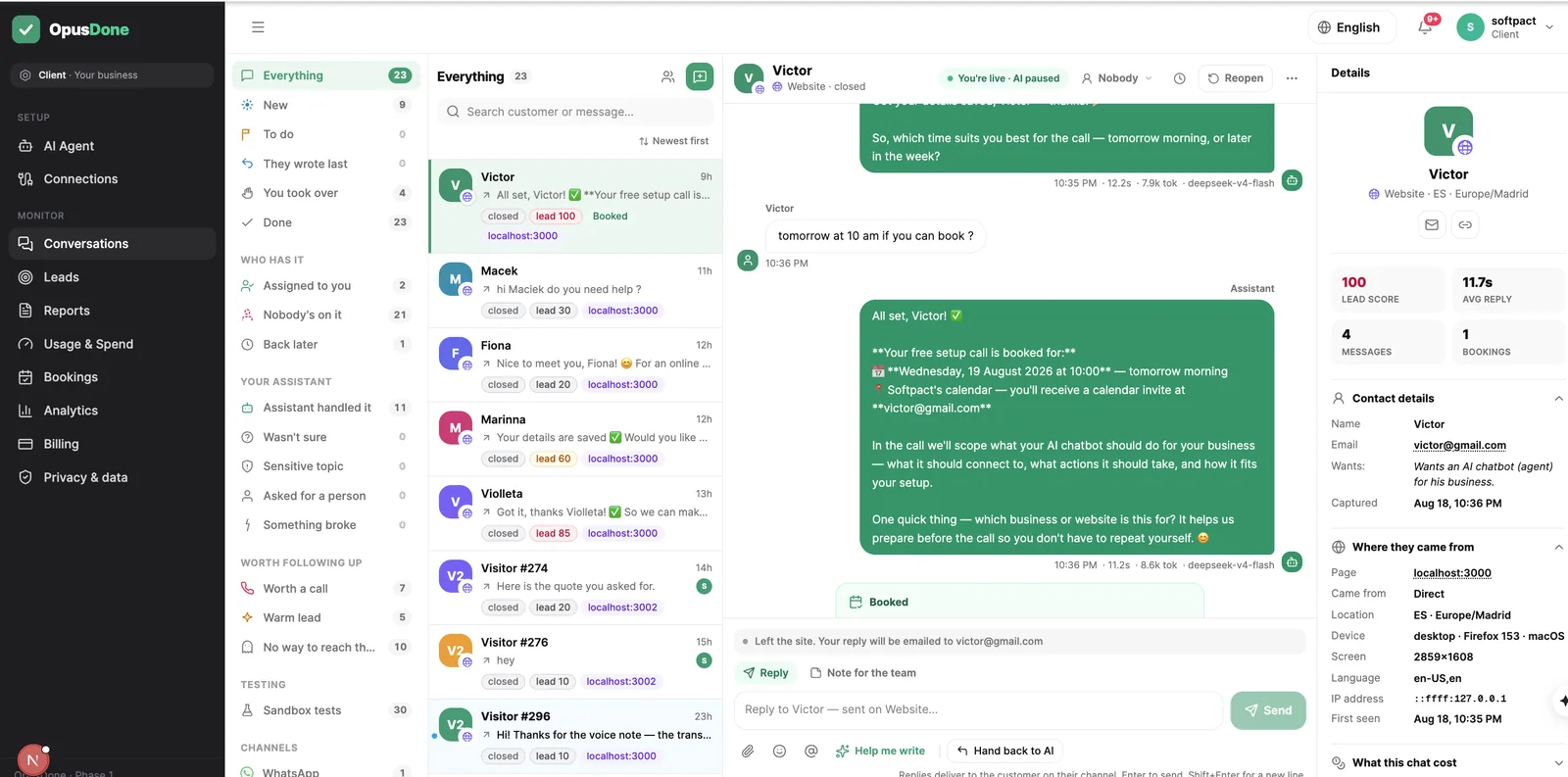
That code opens our own OpusDone assistant — the same assistant your property would get. One property or forty — each gets its own code and its own knowledge, and nothing from one property is ever visible to a guest in another.
You have answered all of this before. Hundreds of times.
None of it is difficult. All of it arrives when there is nobody at the desk.
The desk closes. The guests do not.
Check-in runs late, the flight lands at one, and the person who knows where the spare towels are went home at ten. A short-term rental has no desk at all — every question becomes a message to a phone somebody is trying not to look at.
Eleven questions, every single guest.
Wifi. Breakfast. Checkout. Parking. Towels. Air conditioning. The bins. The beach. Late arrival. Luggage after checkout. Somewhere to eat. Every one of them has been answered before, out loud, by somebody carrying something.
The good recommendation never gets made.
You know the bakery that opens at seven and the place two streets back that is better than anything on the front. Nobody is there to say it, so the guest eats at the chain on the corner and writes that you had no local knowledge.
Three jobs, and it does not invent any of them.
The eleven questions, in whatever language they arrive in
Breakfast, wifi, checkout, parking, air conditioning, the bins, the nearest pharmacy. Answered from the knowledge you wrote and approved — and if you have not told it something, it says so rather than guessing. A guest who writes in Dutch gets Dutch back.
Knowledge you have not marked live is never used.
Your recommendations, not a search engine’s
The bakery that opens at seven. The restaurant that will take a table of six without notice. The beach that is not the one on the postcard. You write the list once; it gives the right part of it to the right guest, at the hour they ask.
It will not recommend a place you never mentioned, and it does not search the web.
Anything that costs you money goes to a person
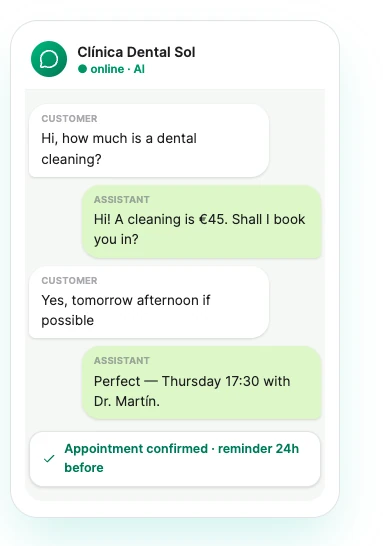
A late checkout, an upgrade, an extra night, a complaint. The assistant takes the request, writes down what was asked and who asked it, and puts it in front of a human — with the whole conversation attached, so nobody has to ask the guest twice.
Escalation is enforced in the runtime, not left to the model to remember.

What happens between ten at night and breakfast.
- 23:40
Room 14 scans the card
“Is breakfast still on tomorrow? We land late.” It answers with the real hours and offers to ask the team about a late one. Nobody’s phone rings.
- 23:41
The request reaches a human
A late breakfast is not the assistant’s to grant, so it becomes a flagged item with the conversation attached. It promises nothing on your behalf.
- 07:05
You open one short list
Not forty transcripts — the two things that needed you, and a note of what was handled on its own while the building was asleep.
The question that decides between you and a 15% commission.
Somebody comparing your own site against a booking platform has one question — is there parking, is it walkable from the station, can we bring the dog. Unanswered, they go back to the platform, and the platform takes its cut of a guest you had already won.
- Answers the pre-booking questions on your own site, at the moment they are asked.
- Passes a real enquiry to you with a name and a way to reach them.
- Never quotes a rate, a room or an availability you have not given it.
- Replies in the language the enquiry arrived in, which decides more bookings here than anywhere.
What it will never do.
This is the block we wrote before the rest of the page. A hotel assistant that is vague about its limits is one that will eventually confirm a room it cannot see.
It does not manage your reservations
No PMS, no channel manager, no availability, no rates, no cancellations, no modifications. It does not work “alongside” one either — there is no integration, and we will not imply there is.
It does not touch the room folio
It can take a deposit or the full price for a service you list — a treatment, a tour, a table — into your own Stripe. It will not hold a card on file, charge for a late checkout, or process a refund.
It does not decide a late checkout or an upgrade
It takes the request and puts it in front of a person with the conversation attached. It never says yes on your behalf.
It does not unlock anything
No door codes, no smart locks, no safe combinations. If your check-in instructions include a code, you decide whether it is in the knowledge base at all.
It does not invent a recommendation
If you have not told it about a restaurant, it says it does not know and offers to ask somebody. It does not search the web on your behalf.
It never pretends to be a person
It says it is an AI assistant in its first sentence, every time, and a member of your team is one message away. That is enforced in code and a client cannot edit it away.
What hoteliers ask us first
Does it connect to my PMS or channel manager?
I let two flats on Airbnb. Is this for me too?
What if it does not know something?
Can my cleaner or my co-host see the messages?
Can guests book a room through it?
What language does it answer in?
Do I have to print anything?
The front desk stays open after everyone goes home.
Breakfast, wifi, checkout, parking, somewhere good to eat — answered at 23:40 in the language the guest typed, from knowledge you wrote. Late checkouts, upgrades and complaints go to a person with the conversation attached, so nothing is ever promised on your behalf.
